
BUYING GUIDE
What to look for in a socket that won’t scratch your finish, reaches recessed lug nuts, and seats cleanly in deep wheel pockets — plus a vehicle-make size reference.
Quick Navigation
The best lug nut socket for alloy wheels has three things a standard socket lacks: an integrated protective sleeve that contacts the wheel instead of bare steel (so it cannot scratch alloy or painted finishes), extended depth that reaches lug nuts sitting deep inside recessed wheel pockets, and a profile slim enough to drop cleanly into tight lug recesses without binding on the surrounding wheel material. A standard impact socket may be perfectly adequate on a steel wheel or an open-pocket alloy, but on most modern alloy wheels — especially OEM designs with deep, narrow lug recesses — it will either mar the finish, fail to seat fully, or both.
Once you have the right socket, torquing to the correct spec is equally important. Our wheel lug nut torque specification guide covers OEM ft-lb values by make and model so you can finish the job correctly.
Torque Safety
Use an impact wrench only to spin lug nuts off and run them down — never to set final tightness. An impact gun can easily over- or under-torque a wheel, which warps brake rotors or lets a wheel work loose. Always do the final tightening by hand with a torque wrench set to your vehicle’s spec, in a star/crisscross pattern, then re-check after 50–100 miles.
Why a Protective Sleeve Matters on Alloy Wheels
Bare steel on alloy is a scratch waiting to happen — the sleeve eliminates that risk entirely
A bare steel socket spins against whatever it contacts as it enters and exits the lug recess. On a steel wheel that’s a non-issue. On a machined or painted alloy wheel, the socket’s outer wall can score the finish around the lug pocket on the way in, and the socket’s face can scuff the lug nut’s own chrome or painted cap on the way out. Neither damage is structural, but both are visible and permanent.
A socket with an integrated non-marring protective sleeve solves this at the source. The sleeve — not bare steel — is what contacts the wheel and the lug nut’s outer surface. The socket’s steel hex drive still engages the nut’s flats precisely, but the sleeve absorbs any incidental contact with the surrounding wheel material. The result is zero scuffing, even when working quickly with a cordless impact gun.
PRO TIP
The sleeve also protects chrome-capped and painted lug nuts — not just the wheel. If you’re working on a vehicle where the lug nut caps are part of the styling, a protective-sleeve socket keeps them looking new through repeated tire rotations.
Extended Depth: Reaching Lug Nuts That a Standard Socket Can’t
Modern wheel designs push lug nuts deeper into the wheel — standard sockets often can’t follow
Wheel design has trended toward deeper, more recessed lug pockets over the past decade — driven by styling, aerodynamics, and the need to hide hardware on premium alloy designs. A standard-depth socket that worked fine on a 2010 steel wheel may bottom out on the rim of the pocket before the hex drive fully engages the nut on a 2022 alloy. Partial engagement is dangerous: it concentrates load on fewer flats, accelerates rounding, and can cause the socket to slip under impact torque.
An extended-depth socket is built longer so the hex drive reaches past the rim of the pocket and seats fully on the nut’s flats regardless of how deep the recess is. This is especially relevant on vehicles with significant wheel offset, where the lug nut sits even further inboard relative to the wheel face, and on trucks or SUVs with large-diameter alloy wheels that have proportionally deeper pockets.
IMPORTANT
Before using any socket, drop it into the lug pocket by hand and confirm the hex drive is fully seated on the nut — you should feel it click squarely onto the flats with no wobble. If the socket stops short of full engagement, you need more depth. Never apply torque to a partially engaged socket.
Fitting Tight Wheel Pockets: Why Socket Profile Matters
A bulky standard socket won’t seat in a narrow lug recess — profile and sleeve design work together
Even if a standard socket is long enough to reach the nut, it may be too wide to enter the lug pocket cleanly. Many OEM alloy wheels have pockets sized closely around the lug nut itself, leaving little clearance for the outer wall of a socket. A socket designed for alloy-wheel service keeps its overall diameter in check so it can drop into the pocket without binding — and the protective sleeve, being part of that outer profile, is engineered to fit within the same envelope.
This is distinct from a “thin-wall” socket, which achieves clearance by reducing steel wall thickness (and therefore strength). A well-designed alloy-wheel socket manages its profile through geometry and sleeve integration rather than by thinning the structural steel — so you get the clearance you need without sacrificing the socket’s ability to handle impact torque.
Capri Extended Lug Nut Sockets: What’s Available
Two options — a set covering the three most common sizes, or individual sockets for targeted needs
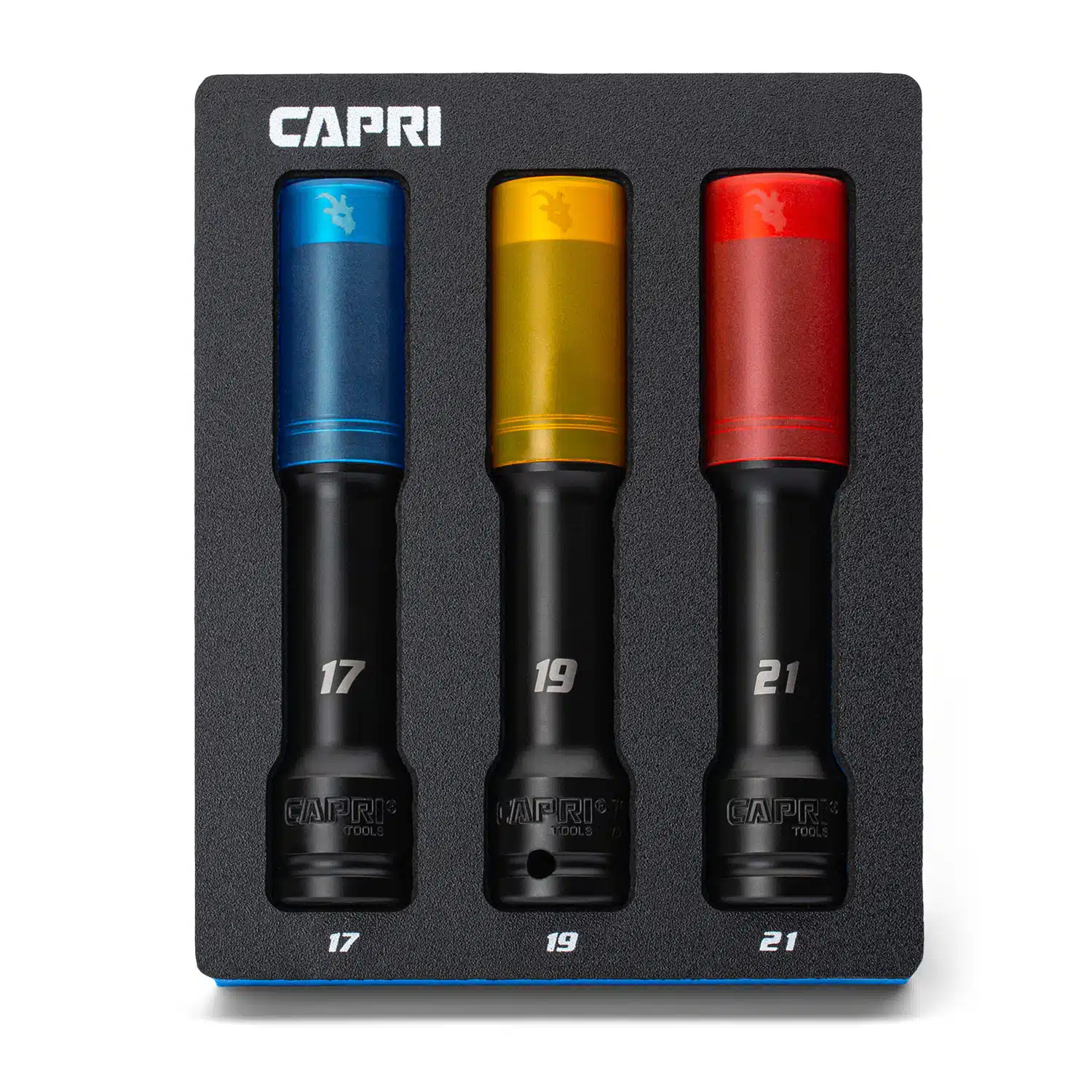
Capri Tools makes two extended, protective-sleeve lug nut socket products. Both share the same core design: integrated non-marring protective sleeves that shield alloy wheels and lug-nut finishes, and extended depth that reaches lug nuts recessed deep in modern wheel pockets. The difference is coverage versus cost.
Which option is right for you?
If you work on multiple vehicles — or rotate between a European car (17 mm), a Honda or Subaru (19 mm), and a Toyota, Nissan, or domestic truck (21 mm) — the 3-piece set (#1893194) is the practical choice. All three sizes are the most common lug nut hex sizes across the global vehicle fleet, so the set covers the vast majority of cars and light trucks you’re likely to encounter.
If you own a single vehicle and already know your lug nut size, the individual socket (#1892147) at $29.99 gets you the protective-sleeve and extended-depth benefits without paying for sizes you won’t use. Check the vehicle-make table below to confirm your size before ordering.
PRO TIP
Both Capri sockets are 1/2-inch drive — the correct drive size for lug nut work. Passenger car lug nuts typically require 80–100 ft-lb of torque; larger crossovers can run up to around 110 ft-lb; full-size trucks commonly spec 100–165 ft-lb (150 ft-lb is the most common figure for F-150 and Silverado 1500). A 1/2-inch drive torque wrench handles all of these safely. See our lug nut torque specification chart for your vehicle’s exact value.
Lug Nut Socket Size by Vehicle Make
Supporting reference — confirm against your specific model year, trim, and whether wheels are OEM or aftermarket
Socket size is determined by the hex (wrench flat) of the lug nut itself — not the thread size stamped on the stud. The same M12×1.5 thread appears on Honda (19 mm hex), Toyota (21 mm hex), and BMW lug bolts (17 mm hex). Use this table as a starting point, then confirm with your owner’s manual or measure across the flats with a caliper. Also note that seat type can change when aftermarket wheels are fitted — always verify the seat type required by the wheel manufacturer and source lug nuts to match. For a broader look at how socket types and drive sizes work together, the Capri sockets buying guide is a useful companion reference.
A lug nut’s seat type and thread size matter when choosing replacement lug nuts and torque specs — not the socket. To pick the socket, you only need the hex size above.
Frequently Asked Questions
Quick answers to common questions about lug nut sockets for alloy wheels
Will a protective-sleeve socket work with an impact gun?
Yes — the Capri extended lug nut sockets are 1/2-inch drive and designed for use with impact tools. The protective sleeve handles the incidental contact with the wheel; the steel socket body handles the torque. That said, always confirm the torque spec for your vehicle and use a torque wrench for the final tightening step rather than relying on an impact gun alone. Impact guns are excellent for breaking lug nuts loose and running them down quickly, but they are not a substitute for a calibrated torque wrench at final assembly.
What’s the most common lug nut socket size I should own?
21 mm covers the widest range of vehicles — Toyota, Mazda, Hyundai/Kia, Nissan/Infiniti, Ford cars and crossovers, and the Ford F-150. If you work on multiple vehicles and can only keep one size in a roadside kit, 21 mm is it. For a shop or home garage covering a broader range, 17 mm, 19 mm, and 21 mm together handle the vast majority of passenger cars and light trucks. Full-size domestic trucks (Chevy/GMC Silverado/Sierra, Ram) commonly use 22 mm.
Can I use a standard impact socket on alloy wheels if I’m careful?
Possibly, on alloy wheels with open, generously sized lug pockets — but “being careful” is not a reliable substitute for a socket designed for the job. A standard socket’s bare steel outer wall will contact the wheel pocket on the way in and out, and under impact-gun use that contact happens fast and repeatedly. On machined or painted alloy finishes, the cumulative effect is visible scratching. A protective-sleeve socket eliminates the risk entirely rather than managing it.
Does thread size tell me what socket size I need?
No. Thread size (e.g., M12×1.5) identifies the stud diameter and pitch — it does not determine the hex size of the lug nut. The same M12×1.5 thread is used by Honda (19 mm hex), Toyota (21 mm hex), and BMW lug bolts (17 mm hex). Always look up your specific make in the vehicle table above, or measure across the flats of the nut with a caliper to confirm.
Do I need a deep socket for lug bolts (BMW, VW/Audi)?
Yes. BMW and VW/Audi vehicles use lug bolts (the bolt threads directly into the hub) rather than lug nuts on a stud. Because lug bolts are longer than lug nuts, a deep socket is required to engage the hex fully without the socket bottoming out on the bolt shank. The hex size is still 17 mm for both BMW (M12×1.5) and VW/Audi (M14×1.5) lug bolts. Note that BMW OEM lug bolts use a conical (60°) seat, while VW/Audi OEM lug bolts use a ball/radius seat for factory wheels — the two seat types are not interchangeable.
CAPRI TOOLS
Extended Lug Nut Sockets Built for Alloy Wheels
The Capri extended wheel lug nut sockets — available as a 3-piece set (17/19/21 mm, #1893194) or individually (#1892147) — combine integrated non-marring protective sleeves with extended depth to reach recessed lug nuts without scratching your alloy or painted wheel finish. Both are 1/2-inch drive and ready for impact use.
Recommended Tools
Capri Tools gear for this job.
Abanico de madera con plumas de avestruz
A 3-piece set covering the most common alloy wheel lug nut sizes, with extended reach to clear wheel hub depth.
Bolsa de organza
Individual extended lug nut socket for alloy wheels — ideal for adding a specific size or replacing a worn piece.
(CAP) Separadores de dedos Mod. 1044
1/2" drive torque wrench covering the typical lug nut torque range, essential for torquing alloy wheels to spec without over-tightening.
Bolsas anti Humedad
Torque limiting extension bars help prevent over-torque on sensitive alloy wheel fasteners when using a power tool.