
BUYING GUIDE
The complete reference for mid-length sockets — exact dimensions, how they compare to shallow and deep, which drive size to choose, and the best sets for DIY and professional use.
Quick Navigation
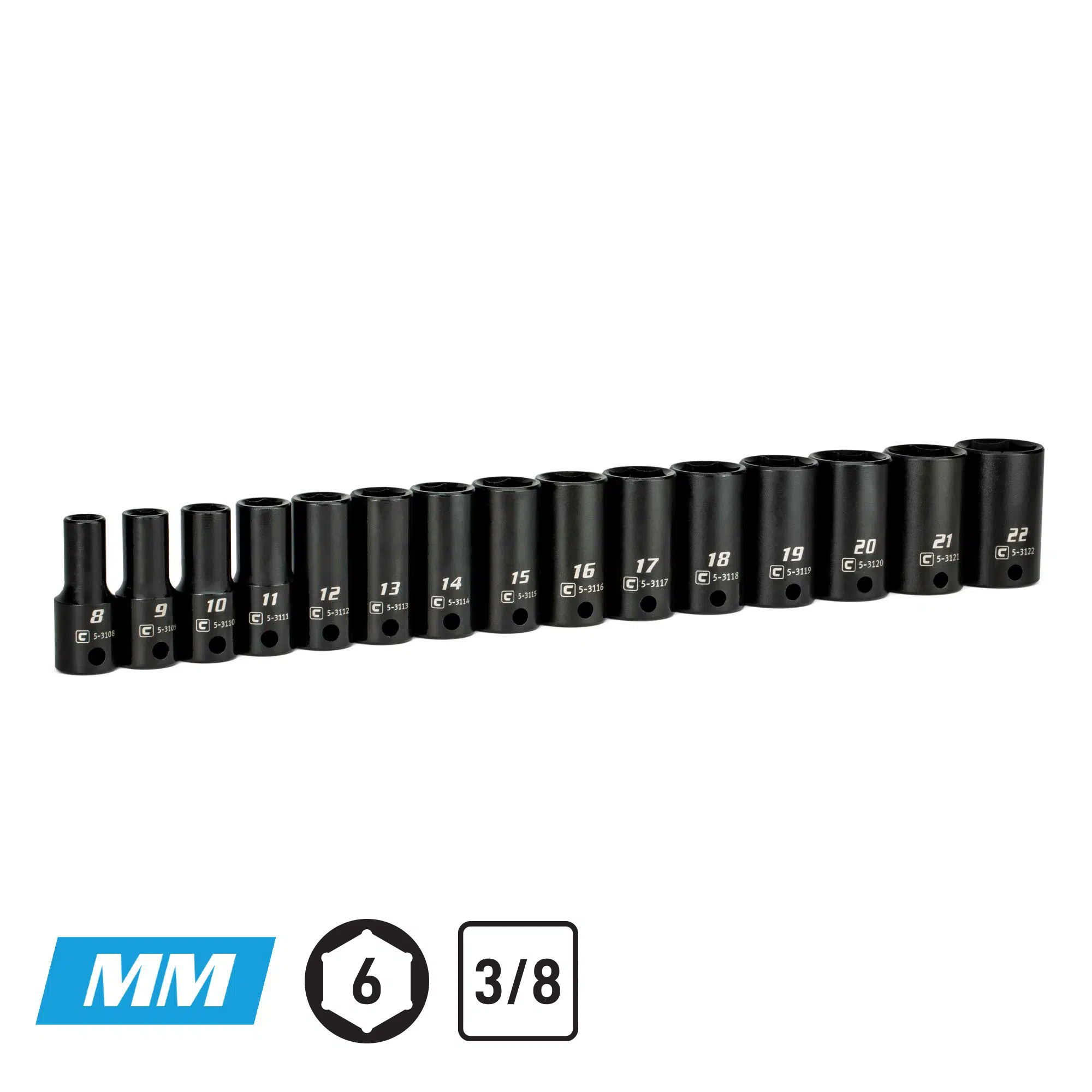
Semi deep sockets — also called mid-length or intermediate sockets — sit between a standard shallow socket and a full deep socket in overall length. In Capri’s 3/8 in drive 6-point impact line, that works out to exactly 1.8 in overall: 50% longer than a shallow (1.2 in) and about 28% shorter than a full deep (2.5 in). They are long enough to clear a bolt or stud that protrudes through a nut, yet short enough to stay rigid, fit in tighter spaces, and remain lighter and easier to maneuver than a deep socket.
If you’ve ever found a shallow socket bottoming out on a protruding stud — but a deep socket flopping around or fouling on a nearby bracket — a semi deep is the tool you were missing. This guide explains the geometry, the use cases, and exactly which sets are worth buying. For a broader look at socket types and materials, see the Capri Tools Sockets Buying Guide.
What Are Semi Deep Sockets?
Defining mid-length sockets and where the name comes from
The socket industry does not have a single universal length standard, so “semi deep” is a functional description rather than a rigid ISO or ASME dimension. Capri Tools uses the term mid-length interchangeably with semi deep — you’ll see both on packaging and in search results, and they mean the same thing. Capri’s own product literature describes their semi deep sockets as about 30% shorter than their standard deep-length sockets, which puts them at roughly 70% of a full deep socket’s overall length.
The key design intent is a socket body deep enough to fully engage a nut sitting on a protruding bolt or stud, while keeping the overall profile compact enough to maintain rigidity under torque and to fit in recessed or partially obstructed fastener locations. The wall thickness is the same as a standard shallow socket of the same series — so strength is not compromised by the added length.
PRO TIP
If you see “mid-length,” “intermediate depth,” or “semi-deep” on a socket label, they all describe the same product category. Search for any of those terms and you’ll land in the same aisle.
Shallow vs Semi Deep vs Deep: How Do the Lengths Actually Compare?
Exact Capri dimensions for 3/8 in drive 6-point impact sockets — and what the numbers mean in practice
The three socket depths each solve a different problem. The table below uses Capri’s published overall lengths for their 3/8 in drive 6-point impact sockets — these are real, confirmed dimensions, not approximations.
Put those numbers in perspective: a semi deep socket is 50% longer than a shallow (1.8 in vs. 1.2 in) — that extra 0.6 in is exactly what clears a bolt protruding through a nut. At the same time, it is about 28% shorter than a full deep (1.8 in vs. 2.5 in), which is enough to meaningfully reduce flex, weight, and profile in tight spaces. And note that a deep socket is more than double the length of a shallow — that is a significant jump that the semi deep splits right down the middle.
Why semi deep is the everyday workhorse
Modern vehicles are engineered with fasteners that typically have only a few threads of bolt protrusion past the nut — enough that a shallow socket bottoms out, but nowhere near enough to justify a full deep socket. Semi deep sockets were designed precisely for this gap. On a typical passenger car or light truck, the majority of underhood, suspension, and brake fasteners fall into this category. Mechanics who have switched to a semi deep set as their primary socket set consistently report reaching for deep sockets far less often.
The shorter body also means less wobble on a ratchet or impact gun, better torque transfer, and a lower profile that clears surrounding components more easily. When you’re working in a tight engine bay, every millimeter of socket length matters.
When Should You Use Each Socket Depth?
Matching the right depth to the job so you’re not fighting the tool
Reach for a shallow socket when…
The fastener is flush with or recessed below the surface — think oil drain plugs, most body bolts, and fasteners in tight vertical spaces where a longer socket would foul on the surrounding structure. At 1.2 in overall, shallow sockets are also the right call when maximum rigidity matters and there is no stud protrusion to worry about.
Reach for a semi deep socket when…
The bolt or stud pokes through the nut by a few threads — the most common scenario on suspension components, brake caliper bolts, engine mount hardware, exhaust manifold studs, and most underhood fasteners on modern cars and trucks. The 1.8 in length clears that protrusion without adding unnecessary bulk. If a shallow socket won’t seat fully and you don’t want the extra length of a deep, semi deep is the answer. For many DIY mechanics working on modern vehicles, a semi deep set handles the large majority of everyday jobs.
Reach for a deep socket when…
The fastener is deeply recessed or the stud protrudes significantly — classic examples are spark plugs (which sit deep in the head), nuts on long all-thread rod, and any application where the socket needs to travel down a tube or well to reach the fastener. At 2.5 in, deep sockets are indispensable in these situations but overkill everywhere else.
PRO TIP
Not sure which depth you need before you start a job? Keep a semi deep set on the ratchet as your default. Switch to shallow only when clearance is tight above the fastener, and switch to deep only when the bolt protrudes more than the nut is tall.
Semi Deep Impact Sockets: Why the Depth Matters Even More with a Gun
Impact-rated mid-length sockets for air and cordless impact wrenches
The semi deep format is especially well-suited to impact use. Impact sockets are made from a tougher, more ductile steel alloy — typically Cr-Mo (chrome-molybdenum) — and have thicker walls than hand-use chrome sockets. That means a full deep impact socket at 2.5 in is noticeably heavier and bulkier than its hand-socket counterpart. A semi deep impact socket at 1.8 in gives you the stud-clearance you need while keeping the mass down, reducing the rotational inertia the gun has to overcome, and improving balance in tight quarters.
For 3/8 in drive impact work — the most common drive size for underhood and undercar jobs — semi deep impact sockets are the format most professional technicians reach for first. The 1/2 in drive semi deep format is popular for suspension and drivetrain work where higher torque is needed but full deep sockets would be unwieldy.
Capri’s 6-Point Semi Deep Impact Sockets are built to this standard — Cr-Mo construction, a manganese phosphate coating for corrosion resistance (a more durable finish than the black oxide coating found on many competing sockets), and a 6-point profile that grips fastener flats rather than corners. Individual sockets run from 6 to 24 mm in metric (and cover a wide SAE range as well), so you can fill gaps in an existing set one size at a time or buy a complete set from the start.
IMPORTANT
Never use chrome hand sockets on an impact wrench. The hardened chrome finish is brittle under impact shock loads and can shatter. Always use impact-rated (Cr-Mo) sockets with any air or cordless impact tool.
Drive Sizes, Point Types, and Metric vs SAE
Choosing the right configuration for your tools and your vehicle
Which drive size for semi deep sockets?
For most DIY mechanics working on passenger cars and light trucks, a 3/8 in drive semi deep set covers the overwhelming majority of jobs. Add a 1/2 in drive semi deep set if you regularly tackle suspension, steering, or drivetrain work.
6-point vs 12-point for semi deep sockets
For impact use and any high-torque application, 6-point is strongly preferred. A 6-point socket contacts the flat sides of the fastener hex, distributing load across a larger surface area and dramatically reducing the risk of rounding a fastener. 12-point sockets offer more engagement positions (useful in tight swing-arc situations) but concentrate force on the corners. For a deeper look at this trade-off, see The Differences Between 6-Point and 12-Point Wrenches and Sockets. For semi deep impact sockets specifically, 6-point is the right choice in nearly every scenario.
Metric vs SAE
Most modern vehicles — including domestic brands — use metric fasteners almost exclusively. If you work on a single modern vehicle, a metric semi deep set is all you need. If you work on older American vehicles, classic cars, or a mixed fleet, an SAE set is worth having. Capri offers both metric and SAE semi deep sets; see the buying section below.
What about semi deep swivel sockets?
Semi deep swivel (flex-head) sockets combine the mid-length body with a pivoting joint that lets the socket tilt off-axis to reach fasteners at an angle. They’re a niche but genuinely useful tool for fasteners that are accessible only at an angle — certain exhaust manifold bolts, some firewall-adjacent hardware, and awkward underbody locations. Standard semi deep sockets are rigid (no pivot). Swivel sockets are a specialty item; most mechanics use a regular semi deep set as their primary kit and add swivel sockets in specific sizes as needed.
Which Semi Deep Socket Set Should You Buy?
Capri Tools semi deep sets matched to the most common use cases
Capri’s semi deep impact socket lineup is built on Cr-Mo steel with a 6-point profile and a manganese phosphate coating — the right spec for both impact and hand-ratchet use. Here’s how to think about the options. Browse the full range at the Capri 6-Point Semi Deep Impact Sockets category page.
3/8 in Drive Semi Deep Sets — Metric and SAE
Capri’s 3/8 in drive semi deep impact sets cover 8–22 mm in metric and 5/16–1 in SAE. The metric set is the right first purchase for anyone working on modern passenger cars or light trucks — that range covers the fasteners you’ll encounter on virtually every underhood and chassis job. The SAE set is the companion piece for older American vehicles, classic cars, or a mixed fleet. Individual sockets are available in every size from 6 to 24 mm (metric) and across a wide SAE range, so you can fill gaps in an existing set without buying a full set again.
The “One Set, Every Depth” Option: CP53000-51MSXD Master Set
If you want to stop thinking about which depth to buy and just have everything, the CP53000-51MSXD 51-Piece Master Set ($139.99) is the answer. It packs all three depths — shallow, semi deep, and deep — for every size from 6 to 22 mm, all in one organized tray. You get the full 1.2 in / 1.8 in / 2.5 in progression for every hex size in the range, so you’re never hunting for the right socket mid-job. For a professional shop or a serious DIYer who wants to buy once and be done, this is the most efficient path to complete coverage.
Our recommendation by use case
Starting out or working on one modern vehicle: The 3/8 in Drive Metric Semi Deep Set (8–22 mm) is the right first purchase. That range covers nearly every fastener you’ll encounter on a modern passenger car or light truck, and the 3/8 in drive pairs with the widest selection of ratchets and extensions.
Mixed fleet or older American vehicles: Add the SAE set (5/16–1 in) alongside the metric set. The two sets together give you comprehensive coverage without duplicating sizes.
Professional shop or serious DIYer: The CP53000-51MSXD Master Set is the most efficient path to full coverage — all three depths, every size from 6–22 mm, organized together in a single tray.
Filling a gap in an existing set: Individual sockets in metric (6–24 mm) and SAE let you add exactly the size you need without buying a full set again.
For more context on how semi deep sockets fit into a complete socket strategy, the Capri Tools Mid-Length Sockets overview page is a good companion read.
Frequently Asked Questions
Quick answers to the most common questions about semi deep sockets
Are semi deep sockets the same as mid-length sockets?
Yes. “Semi deep,” “mid-length,” and “intermediate depth” are all names for the same socket category — a body longer than a standard shallow socket but shorter than a full deep socket. Different brands use different terms; Capri Tools uses “mid-length” on its packaging and “semi deep” in search-friendly contexts because that’s the term most mechanics search for.
Can I use semi deep impact sockets with a hand ratchet?
Yes. Impact-rated sockets (Cr-Mo construction, manganese phosphate finish) work perfectly with a hand ratchet or breaker bar — they’re simply built to a tougher standard than chrome hand sockets. The reverse is not true: chrome hand sockets should never be used on an impact wrench.
Do I still need deep sockets if I have a semi deep set?
For most DIY mechanics, a semi deep set handles the large majority of jobs. You’ll still want deep sockets for spark plugs (which require a deep well to reach down into the head), any application with long all-thread rod, and deeply recessed fasteners. If you work on a modern vehicle and don’t do your own spark plugs, you may find you rarely need deep sockets at all. The CP53000-51MSXD Master Set is the cleanest solution if you want all three depths on hand without thinking about it.
What’s the difference between semi deep swivel sockets and regular semi deep sockets?
A swivel (flex-head) semi deep socket has a pivoting joint between the drive end and the socket body, allowing the socket to tilt off-axis. This lets you engage a fastener that isn’t directly in line with your ratchet — useful for awkward angles in tight engine bays. Standard semi deep sockets are rigid (no pivot). Swivel sockets are a specialty item; most mechanics use a regular semi deep set as their primary kit and add swivel sockets in specific sizes as needed.
Is 3/8 in or 1/2 in drive better for semi deep sockets?
3/8 in drive is the better starting point for most mechanics — it covers the full range of underhood and general chassis fasteners, pairs with a wider variety of ratchets and extensions, and is lighter and easier to maneuver. 1/2 in drive is the right choice when you need higher torque output for suspension, drivetrain, or heavy-duty fasteners. Many mechanics own both; if you can only start with one, choose 3/8 in drive.
SHOP CAPRI TOOLS
Find the Right Semi Deep Socket Set for Your Work
Capri’s 6-Point Semi Deep Impact Sockets are available in metric and SAE, 3/8 in drive sets, individual sockets from 6–24 mm, and the CP53000-51MSXD 51-piece master set that includes all three depths. Built from Cr-Mo steel with a manganese phosphate coating for impact and hand use.
Recommended Tools
Capri Tools gear for this job.
Bolsas anti Humedad
The direct answer to the article’s ‘which set to buy’ question — a purpose-built 3/8" drive semi-deep socket set in metric sizes.
Tubo de tela y silicón para dedos
For readers who need to fill gaps or replace individual sizes rather than buying a full set.
(CAP) Separadores de dedos Mod. 1043
Keeps a new semi-deep socket set organized and accessible in the toolbox — a natural companion purchase.